International Morse Code: The Complete Standard, History, and How It Works
International Morse code is the standardized system of dots and dashes officially adopted at the 1865 International Telegraph Convention in Paris and maintained today by the International Telecommunication Union under recommendation ITU-R M.1677-1. It’s the version almost everyone means when they say “Morse code” used by amateur radio operators, aviation navigation beacons, and emergency signaling worldwide and it’s distinct from the earlier, less consistent American Morse Code that Samuel Morse and Alfred Vail originally developed for the US telegraph network in the 1840s.
This guide covers exactly what this standard is, where it came from, the precise timing rules that define it, how it differs from the American Morse Code it replaced, and where it’s still actively used more than 150 years after it was first standardized. Use our Morse Code Translator to convert text into Morse code.
What Is International Morse Code?
International Morse code represents every letter, digit, and common punctuation mark as a unique sequence of short signals (“dits,” shown as dots) and long signals (“dahs,” shown as dashes). Unlike its predecessor, it uses only two signal lengths with a strict, fixed timing ratio, and every character is transmitted as one uninterrupted pattern no pauses inside a single letter, only between letters and words. That structural discipline is precisely what makes it reliable enough to be read by ear, light, or machine, even under poor signal conditions.
Who Governs International Morse Code Today?
The modern specification is maintained by the International Telecommunication Union (ITU), a United Nations specialized agency, under recommendation ITU-R M.1677-1. This document defines the exact dot-dash pattern for every letter, numeral, punctuation mark, and procedural signal (prosign) in the system, along with the formal timing relationships between them, ensuring the same pattern for “A” or “5” is recognized identically by an operator in any country.
The History of International Morse Code
It wasn’t the first version of Morse code it was a deliberate redesign of an earlier, more error-prone system, built specifically to solve problems that showed up as telegraph networks crossed national borders. Study every letter in the Morse Code Alphabet.
American Morse Code: The Original 1844 System
Samuel Morse and Alfred Vail developed the original Morse code in the 1830s and 1840s for the American telegraph network, sending the first public message “What hath God wrought” between Washington and Baltimore on May 24, 1844. This original system, now called American Morse Code, used dashes of inconsistent length and, notably, included small internal pauses within some letters, which worked reasonably well on the mechanical paper-tape recorders of the era but caused real problems as networks grew and signal quality varied.
Friedrich Gerke's 1848 Revision
In 1848, German telegrapher Friedrich Clemens Gerke was tasked with adapting the telegraph line between Hamburg and Cuxhaven, and he recognized that American Morse’s internal letter spacing and inconsistent dash lengths were a liability for accuracy. Gerke reworked roughly half the alphabet, eliminated internal pauses within letters entirely, and fixed the dash-to-dot ratio at a strict 3:1 creating what became known as “Continental Morse” or “Gerke’s Code,” the direct ancestor of the standard we know today.
The 1865 Paris Convention: International Morse Code Becomes Official
As telegraph networks began crossing borders, operators needed one shared code rather than translating between incompatible national systems. The International Telegraph Union (a precursor to today’s ITU) convened in Paris in 1865 and formally adopted a cleaned-up version of Gerke’s code as the shared European standard, which came to be known as International Morse Code specifically to distinguish it from the American original.
From Telegraph Standard to ITU-R M.1677-1
As radio replaced the telegraph through the 20th century, this system proved even better suited to sound-based transmission than it had been to wired telegraphy, since its clean, space-free letter patterns are easy to recognize by ear. The standard was carried forward through successive international telecommunication agreements and now exists formally as ITU-R M.1677-1, the reference still used by amateur radio operators, aviation systems, and maritime services today.
How International Morse Code Works
The Dit-Dah Ratio
Every signal in the system is built from just two lengths: a short signal (dit, shown as a dot) and a long signal (dah, shown as a dash) that lasts exactly three times as long as a dit. This fixed 3:1 ratio, rather than the American system’s variable-length dashes, is one of the core reasons it’s easier to learn and more reliable to transmit accurately. See the system applied to the universal distress signal in SOS Morse Code.
Timing and Spacing Rules
Beyond the basic dit-dah ratio, the standard follows precise spacing rules that separate meaning:
- The gap between dits and dahs within a single letter equals one dit length
- The gap between two letters within the same word equals three dit lengths
- The gap between two words equals seven dit lengths (commonly written as a forward slash, “/”)
These consistent, mathematically defined gaps are what let a trained operator (or a piece of decoding software) reliably tell where one letter ends and the next begins, purely from timing.
No Internal Spaces Within a Letter
Perhaps the single biggest structural difference from American Morse Code is that in this system, every letter is one continuous, unbroken sequence of dits and dahs, with zero silence inside it. American Morse, by contrast, included small internal pauses within several letters, a design that worked on physical paper tape but became a serious liability once operators needed to copy signals by ear over noisy, long-distance lines.
International Morse Code vs. American Morse Code
Feature | International Morse Code | American Morse Code |
Developed / adopted | Internationally standardized in 1865 at the International Telegraph Convention in Paris | Developed in the 1840s by Samuel Morse and Alfred Vail for American telegraph systems |
Main signal elements | Dots and dashes, with standardized timing | Dots, dashes, and intra-character spaces used as part of some characters |
Letter structure | Each letter is a continuous sequence of dots and dashes | Some characters contain internal pauses, making their patterns more variable |
Timing standard | Standardized unit timing: a dash is 3 dot units, with defined gaps between elements, letters, and words | Timing was less uniform and included distinctive internal spacing within some characters |
International standard | Defined for modern use by ITU-R M.1677-1 | No longer an international communications standard |
Historical use | Telegraphy, radio, amateur radio, maritime and other communications | Primarily used in early American telegraph networks and later in some U.S. railroad systems |
Modern status | Still recognized and used worldwide, especially by amateur radio operators | Historical system, mainly studied for telegraph and communications history |
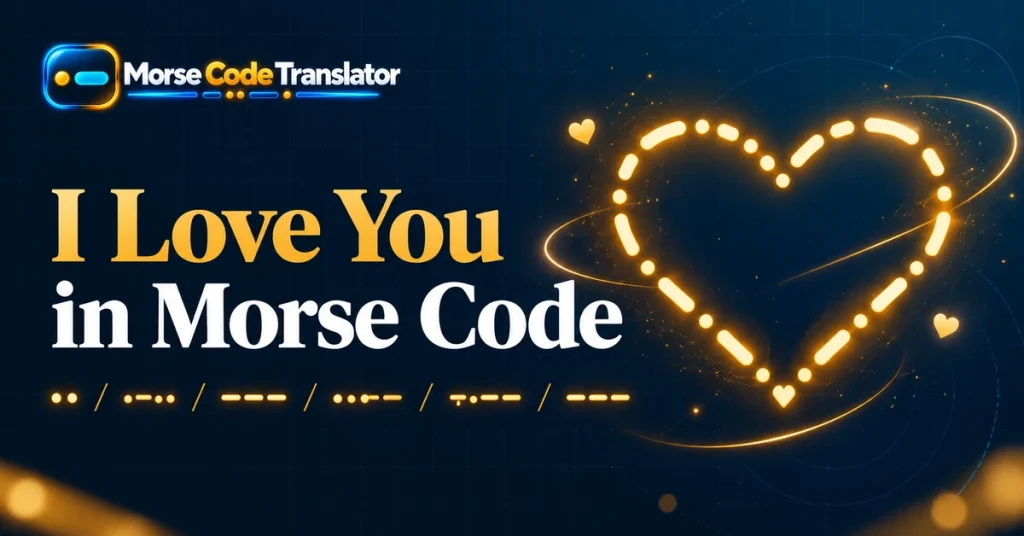
Roughly half the alphabet was recoded between the two systems for example, the letter O changed from a spaced pattern in American Morse to a clean triple-dash (−−−) in the modern standard. Notably, E (a single dit) and T (a single dah) stayed identical in both systems, which is part of why they remain the fastest letters to learn today. Practise a personal phrase with I Love You in Morse Code.
What International Morse Code Covers
The standard defines a complete character set, not just the 26-letter alphabet:
- Letters A–Z: each assigned a unique one-to-four-signal pattern based partly on letter frequency in the alphabet (E and T, the most common letters, get the shortest codes)
- Numbers 0–9: each using a fixed five-signal pattern, following a symmetrical “staircase” logic
- Punctuation: periods, commas, question marks, and other common marks each have an assigned pattern under the standard
- Prosigns: procedural signals like SOS (the international distress call), AR (“end of message”), and SK (“end of contact”), which are sent as single unbroken units rather than following normal letter spacing
Where International Morse Code Is Used Today
Even though voice and digital communication have replaced Morse code for nearly all everyday use, this standard remains genuinely active in several specific fields. Learn an emergency phrase with Help Me in Morse Code.
Amateur (Ham) Radio
Licensed operators use it as part of CW (continuous wave) transmission, valued for its ability to get a signal through under weak or noisy conditions where voice communication fails.
Aviation and Maritime Navigation
Some aviation VOR and NDB beacons, along with certain maritime navigation aids, still identify themselves by transmitting their call sign using it, letting pilots and navigators audibly confirm they’re tuned to the correct station.
Emergency and Backup Signaling
Because it can be sent with nothing more than a light, whistle, or tapped surface, it remains a recommended fallback distress method for hikers, sailors, and anyone facing a communication failure with no working electronics.
Accessibility Technology
This system has long been adapted as a switch-based input method for people with limited mobility, allowing text entry through simple binary switches rather than a standard keyboard.
Why International Morse Code Became the Global Standard
The standard succeeded where the earlier American system couldn’t scale, for a combination of practical reasons: its fixed 3:1 timing ratio and space-free letters made it far more reliable over noisy or long-distance lines, its logic translated cleanly from wired telegraphy to audio radio transmission, and having one shared standard eliminated the costly, error-prone process of recoding messages between incompatible national systems at every border crossing.
By the early 20th century, most of the world outside the United States had already adopted it, and it eventually became the universal reference for anyone transmitting Morse code by any medium.
Frequently Asked Questions
When people say "Morse code" today, they almost always mean International Morse code — the 1865 standard defined under ITU-R M.1677-1. The original 1840s system, now called American Morse Code, is a different, largely historical code with variable dash lengths and internal letter spacing.
Samuel Morse and Alfred Vail created the original telegraph code in the 1840s, but the version known today as International Morse Code came from Friedrich Clemens Gerke's 1848 revision, formally adopted at the 1865 Paris International Telegraph Convention.
Yes, primarily in amateur radio (CW operation), some aviation and maritime navigation beacons, backup emergency signaling, and accessibility technology — even though it's no longer required for most radio licensing.
The International Telecommunication Union (ITU), a United Nations specialized agency, maintains the current specification under recommendation ITU-R M.1677-1.
Fixing the system to exactly two signal lengths — a dit and a dah at a strict 3:1 ratio — with no internal spacing within letters made it far more reliable to transmit and decode accurately, especially over noisy lines or by ear, compared to the more variable, error-prone American Morse Code it replaced.
Final words
More than 150 years after the 1865 Paris convention, the standard remains the same clean, two-signal system built for reliability first which is exactly why it outlasted its more complicated predecessor and is still taught, used, and recognized worldwide today. Whether you’re studying the full alphabet, learning the numbers, or just curious how a 19th-century telegraph standard still shows up in ham radio and emergency signaling, this system is worth understanding as more than a chart of dots and dashes: it’s a deliberately engineered system, refined over decades to be as fast and unambiguous as possible.
Pingback: Morse Code Alphabet Chart – A–Z, Numbers & Symbols
Pingback: I Love You in Morse Code – How to Write & Read It
Pingback: SOS Morse Code - morsecodes-translator.com
Pingback: Help Me in Morse Code – How to Write, Read & Understand